
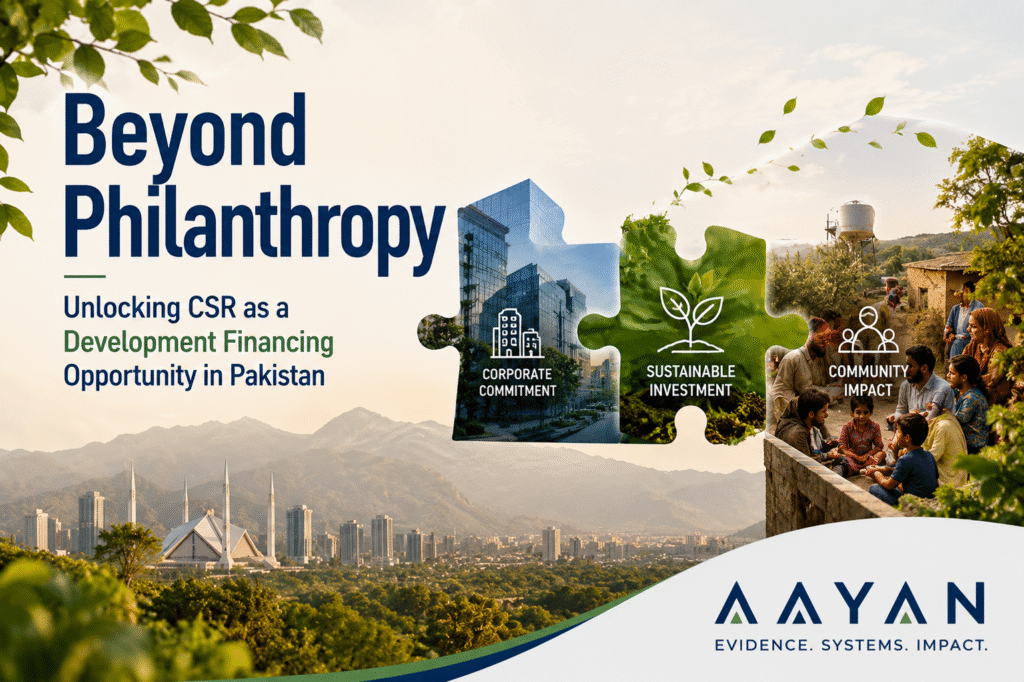
Corporate Social Responsibility (CSR) has become an increasingly visible part of Pakistan’s corporate landscape. Many national and multinational companies operating in the country support initiatives in education, healthcare, disaster response, environmental sustainability, livelihoods, and community development. Publicly available CSR reports, corporate disclosures, and industry publications indicate that businesses are already investing significant resources in social and development initiatives across Pakistan.
Yet an important question receives far less attention:
Can CSR play a more strategic role in Pakistan’s development financing landscape?
Much of the public discussion around CSR continues to focus on philanthropy, charitable giving, relief efforts, and community welfare activities. While these contributions remain valuable, international experience and evolving corporate practices increasingly view CSR as a broader form of social investment—one that seeks measurable outcomes, sustainability, accountability, and long-term impact.
This shift presents an opportunity for Pakistan.
Moving Beyond Charity
Pakistan faces complex and interconnected development challenges, ranging from education and healthcare to climate resilience, livelihoods, social inclusion, governance, and community development. Addressing these challenges requires sustained investment, effective institutions, and strong partnerships.
At the same time, development financing models continue to evolve globally. Governments, development agencies, philanthropic institutions, private foundations, and businesses are increasingly exploring new approaches to financing social impact. The focus is gradually shifting from isolated interventions towards collaboration, sustainability, innovation, and measurable results.
In this context, CSR should not be viewed solely as an act of corporate generosity. It can also be considered a mechanism for supporting broader development objectives through strategic and accountable social investment.
CSR in Pakistan: An Existing Foundation
CSR is not a new concept in Pakistan. Corporate networks, industry associations, and sustainability reports suggest that companies operating in Pakistan already invest substantial resources in education, health, disaster response, environmental initiatives, community development, and social welfare programmes.
The Securities and Exchange Commission of Pakistan (SECP) has also encouraged responsible business practices through its CSR and corporate governance frameworks. Similarly, industry bodies and philanthropic institutions continue to promote greater transparency, reporting, and engagement around corporate social investment.
The issue, therefore, is not whether CSR exists.
The more important question is whether its development potential is being fully realised.
An Opportunity for Stronger Partnerships
Pakistan possesses a diverse ecosystem of civil society organisations, community institutions, social enterprises, academic organisations, and development practitioners working across a wide range of sectors and thematic areas.
At the same time, companies seeking to generate social impact often require credible implementation partners, local knowledge, community trust, technical expertise, and systems for measuring results.
This presents an opportunity for stronger collaboration.
While corporate social investment and civil society engagement are both active in Pakistan, publicly available discussions on structured partnerships between the two remain relatively limited. Yet there appears to be considerable potential for collaboration in areas such as education, skills development, women’s economic empowerment, climate adaptation, community resilience, local governance, and social inclusion.
Such partnerships can combine the strengths of both sectors. Companies bring financial resources, innovation, managerial expertise, and operational efficiency. Development organisations contribute contextual understanding, community relationships, technical knowledge, and implementation experience. Together, these capabilities can create more sustainable and impactful development outcomes.
From Spending to Impact
The future of CSR may depend less on how much is spent and more on how effectively social investments are designed, implemented, measured, and sustained.
This requires moving beyond activity-based reporting towards a stronger focus on outcomes and impact. It also requires greater attention to accountability, transparency, evidence, and learning.
As expectations around responsible business practices continue to evolve globally, organisations are increasingly being asked not only what they spend, but also what difference their investments make.
This creates an opportunity to strengthen the role of monitoring, evaluation, learning, impact measurement, and value-for-money approaches within CSR initiatives.
What Pakistan Needs
Realising the full potential of CSR will require stronger systems and more effective collaboration mechanisms.
There is a need for platforms, partnership models, and intermediary functions that can help connect corporate social investment with credible development actors, facilitate due diligence, strengthen transparency, support impact measurement, and encourage evidence-based decision-making.
The objective is not to replace existing CSR approaches or suggest that all corporate social investment should be channelled through civil society organisations. Rather, it is to expand the range of partnership options available and create more structured pathways for collaboration where they can add value.
Doing so can help increase the effectiveness, accountability, and sustainability of social investments.
Looking Ahead
CSR is already contributing to Pakistan’s social and development landscape. The next step is to explore how that contribution can become more strategic, more evidence-driven, and more closely connected to long-term development outcomes.
As discussions around sustainable development financing continue to evolve, CSR deserves to be viewed not only as philanthropy, but also as a potential catalyst for broader partnerships, innovation, and impact.
The question is not whether CSR has a role in Pakistan’s future.
The more important question is how that role can evolve from charitable giving to strategic investment in sustainable social development.
Suggested References
- Pakistan Centre for Philanthropy (PCP)
- Overseas Investors Chamber of Commerce & Industry (OICCI) CSR and Sustainability Resources
- Securities and Exchange Commission of Pakistan (SECP) Corporate Social Responsibility Guidance
- Asian Development Bank (ADB) CSR and Partnership Initiatives in Pakistan
Series: CSR and Development Financing in Pakistan (Part 1)
This article is the first in a series exploring Corporate Social Responsibility (CSR), development financing, social impact, accountability, and partnerships in Pakistan.
About the Author
Ajmal Elahi is the Founder of AAYAN Management Solutions and a Monitoring, Evaluation, Accountability and Learning (MEAL) specialist with over 18 years of experience working with bilateral and multilateral donors, international NGOs, civil society organisations, government institutions, and rural support programmes. His areas of interest include evidence systems, development financing, governance, learning, accountability, social impact, and institutional strengthening.
About AAYAN Knowledge Hub
AAYAN Knowledge Hub is a platform for sharing evidence, insights, learning, and practical perspectives on development, governance, monitoring and evaluation, research, sustainability, social impact, and institutional strengthening. Through thought leadership articles, learning briefs, case studies, and commentary, the Hub aims to promote informed discussion and evidence-based decision-making across the development and public sectors.
AAYAN Management Solutions
Evidence. Systems. Impact.