
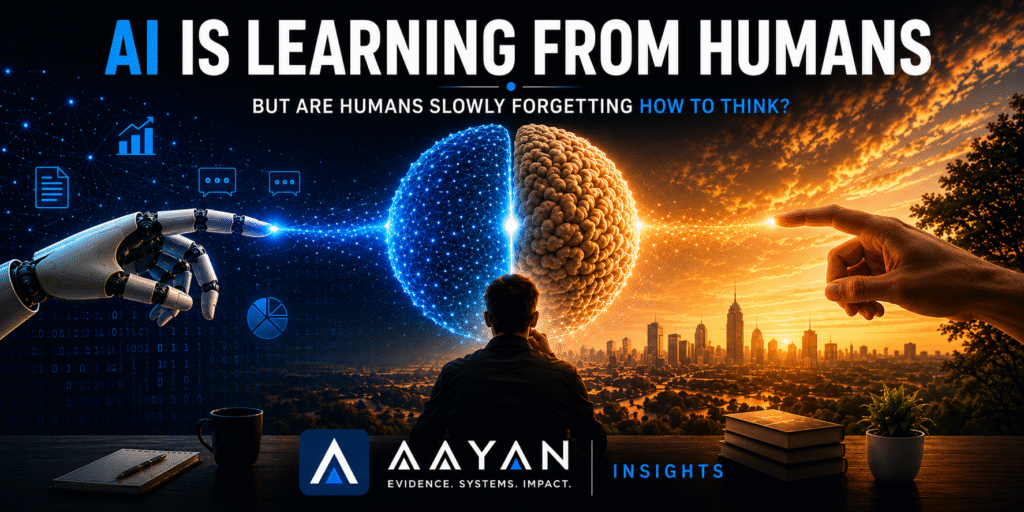
As Artificial Intelligence becomes increasingly integrated into professional and organisational workflows, important questions are emerging not only about what AI can do, but also about how it may be influencing human learning, analysis, and decision-making. This article reflects on some of these opportunities and concerns from a development, governance, research, and MEL perspective.
Artificial Intelligence is no longer just a future discussion. It has already become part of daily professional life. Writing reports, preparing presentations, analysing data, developing visuals, coding, and even brainstorming ideas are now increasingly supported through AI tools.
Across sectors, including governance, development, Monitoring, Evaluation and Learning (MEL), and research, AI is helping individuals and organisations complete work faster and with far less effort than before. Tasks that previously took days can now often be completed within hours.
For developing countries like Pakistan, this shift also brings opportunities. Many smaller organisations, researchers, and young professionals now have access to technical support and tools that were previously available mainly to larger institutions with stronger resources and specialised teams.
There is no doubt that AI is useful. In many situations, it is genuinely helping people improve efficiency and manage workloads. But at the same time, an important question is slowly emerging:
If AI continues to think for humans, what happens to human thinking itself?
AI Is a Powerful Support Tool — But It Is Still a Tool
In the development and MEL sector, AI is already supporting many functions that are usually time-consuming and resource-intensive. It can help structure reports, summarise information, support data analysis, generate visual representations, improve presentations, and organise large volumes of information quickly.
For professionals working under constant deadlines, especially in humanitarian and development environments, this support is extremely valuable.
Realistically, AI is not going away. Its role will continue expanding across sectors. The issue, however, is not the use of AI itself. The concern starts when people begin treating AI-generated content as final thinking rather than a starting point for human review, analysis, and judgement.
The Problem Is Not AI Alone — It Is How Humans Are Using It
One of the most noticeable changes today is that many people are no longer using AI only as a support tool. Increasingly, they are depending on it to perform part of the thinking process itself.
Instead of reviewing information carefully, understanding context, checking technical accuracy, and refining outputs, some users simply generate responses and use them directly.
This is already becoming visible in professional environments. In several cases, reports and documents contain polished language but completely incorrect contextual interpretation because AI has interpreted information through generic patterns rather than actual programme understanding.
For example, in one case, the abbreviation “DSO,” referring to a “Data Support Officer,” was converted into “District Support Officer.” Similarly, “DSP,” intended to mean “Downstream Partner,” became “District Service Provider.”
On the surface, these may appear to be minor mistakes. However, in programme reporting, governance systems, and technical documentation, such changes can significantly alter meaning and interpretation.
The more worrying aspect is that these errors sometimes pass through review processes unnoticed because people increasingly trust polished language more than they verify actual content.
This is where the real gap appears. AI can generate content quickly, but it still cannot replace contextual understanding and human judgement.
AI Still Gets Things Wrong — Even After Detailed Instructions
One reality that people working closely with AI are already experiencing is that, even after detailed discussions, repeated instructions, and continuous back-and-forth engagement, AI can still generate inaccurate responses with confidence.
Sometimes the structure looks impressive, the language sounds polished, and the response appears professional, but the actual interpretation is weak, generic, or entirely off-context.
This becomes even more problematic in sectors involving governance, development, research, and social systems, where context often matters more than language alone. AI does not truly understand field realities, institutional dynamics, organisational culture, political sensitivities, human emotions, or social complexities in the way people do.
It predicts responses based on patterns from existing human-generated information. That distinction matters.
AI is learning from humans. It is not independently understanding society in the way humans do. And this is exactly why human involvement remains critical.
The Bigger Risk: Declining Intellectual Effort
Technology has always changed the way humans work. But this shift feels different because it directly affects cognitive effort itself. There is a growing risk that convenience may slowly replace intellectual engagement.
When people become too dependent on generated outputs, they may gradually lose patience for reading deeply, analysing carefully, writing thoughtfully, and questioning information critically.
The concern is not only about incorrect reports or weak outputs. The deeper concern is whether overdependence on AI may gradually weaken independent thinking over time.
This is particularly important in educational and professional environments where analytical thinking already needs strengthening. If future generations become more comfortable receiving instant answers than understanding concepts themselves, the long-term implications may extend far beyond productivity gains.
The Future Cannot Be Human vs AI
Rejecting AI is neither realistic nor useful. AI will continue reshaping workplaces, institutions, research environments, and professional systems across the world.
The real challenge is not whether AI should be used. The challenge is ensuring that, while AI continues supporting efficiency and productivity, humans do not stop thinking critically themselves.
AI can genuinely improve efficiency and reduce repetitive workloads, but critical thinking, judgement, and contextual understanding still cannot be outsourced completely.
AI will continue improving. That is inevitable.
The more important question is whether humans will continue improving alongside it—or gradually become dependent on systems that think on their behalf.
About the Author
Ajmal Elahi is the Founder of AAYAN and an evidence, learning and advisory specialist with over 18 years of experience working across governance, development, humanitarian and institutional strengthening programmes. His work spans monitoring, evaluation, research, organizational learning, value for money, institutional performance, governance systems, digital transformation and evidence-informed decision-making. Through AAYAN, he works with development partners, public institutions and organizations to strengthen systems, improve performance and bridge evidence, systems and impact.
About AAYAN Knowledge Hub
This article is part of AAYAN’s Knowledge Hub, a platform for sharing practical insights, evidence, systems thinking and perspectives on monitoring, evaluation, learning, governance, institutional performance, digital transformation and sustainable impact.
Related Articles
• Understanding MEAL: Monitoring, Evaluation, Accountability and Learning
https://ayansolutions.net/understanding-meal/
• MEL: High Expectations, Limited Investment – A Gap That Continues to Be Overlooked
https://ayansolutions.net/mel-high-expectations-limited-investment/