
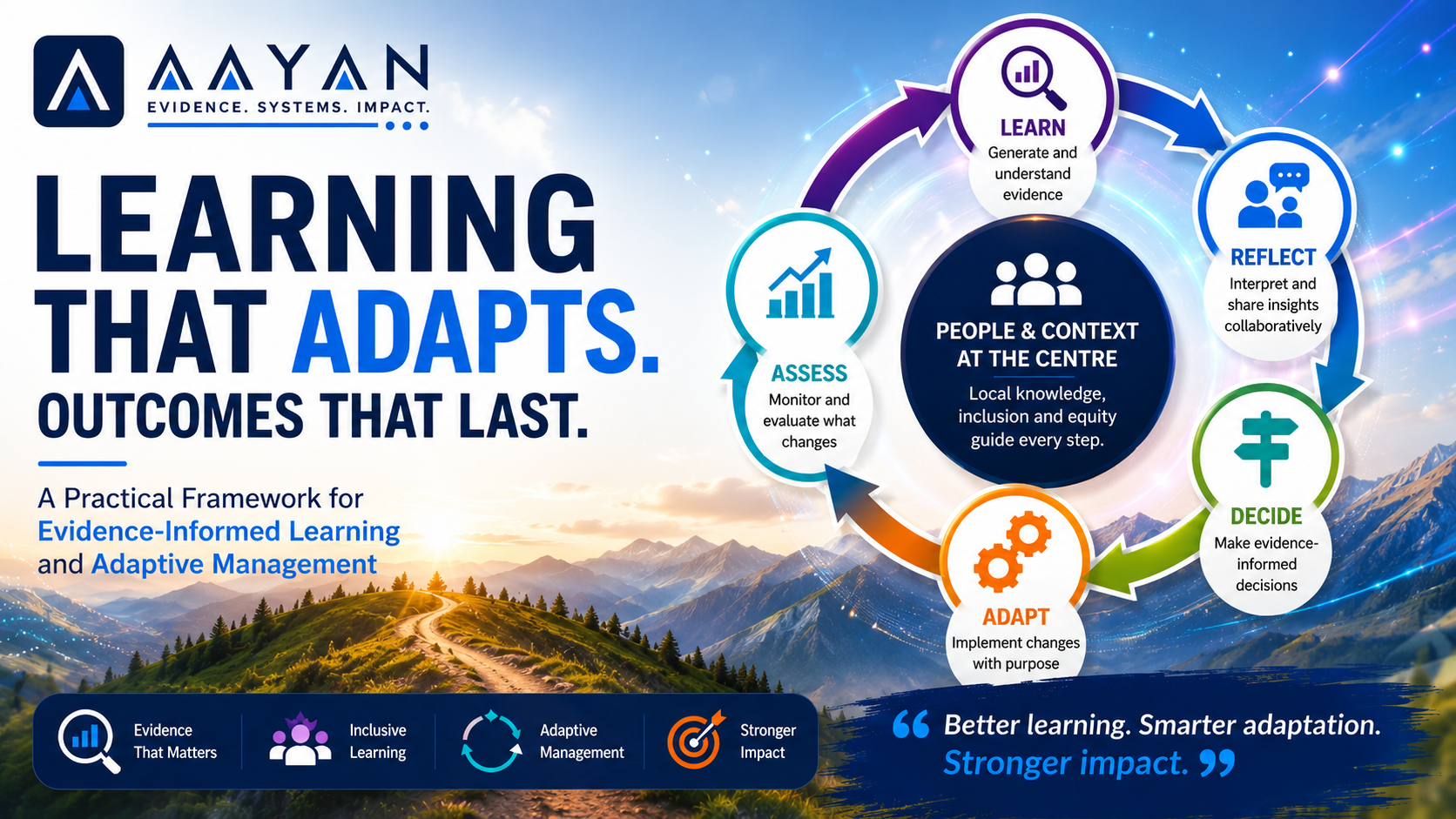
Figure 1: From evidence to decision, adaptation and lasting impact.
About this Article
This AAYAN Knowledge Hub article brings together established thinking and practice on monitoring, evaluation, organisational learning and adaptive management into a practical approach to learning and adaptation in development programmes. The AAYAN Adaptive Learning Cycle provides a practitioner-oriented synthesis of these ideas, connecting evidence, reflection, decision-making, adaptation and follow-through within a coherent programme-management process. It does not claim to originate the individual concepts and practices on which the framework draws.
Executive Summary
Development programmes increasingly work with multiple sources of evidence. Monitoring systems track implementation and results. Evaluations examine performance, outcomes and the factors that help explain them. Research, participant feedback, political economy and contextual analysis, financial information and implementation experience provide additional perspectives on what is happening around a programme. Yet the availability of evidence does not by itself ensure that programmes learn from it or use it consistently in decision-making.
This article describes this disconnect as the Learning Gap: the points at which evidence fails to influence understanding, decisions, programme adaptation or future practice. The gap may occur because evidence is weak, but it can also arise when credible findings are not interpreted collectively, when decision authority is unclear, when teams lack space for honest reflection, when agreed changes are not implemented, or when adaptations are made without subsequently assessing whether they worked. Closing this gap requires a stronger connection between monitoring, evaluation, learning and programme management.
Drawing on established academic thinking and development practice on organisational learning, evidence use and adaptive management, this article brings these principles together in the AAYAN Adaptive Learning Cycle. The cycle provides a practical way of understanding how programmes can move from observation and evidence generation to interpretation, reflection, decision-making, adaptation and implementation, and then assess whether those adaptations worked and embed useful learning in future practice. Its individual elements are well established across the literature and practitioner guidance; the purpose of bringing them together is to make the connections between evidence, decisions, action and institutional learning more explicit and usable for programme teams:
Observe → Generate Evidence → Interpret → Reflect → Decide → Adapt → Implement → Monitor → Evaluate the Adaptation → Institutionalise Learning.
The individual elements of the cycle are grounded in established thinking and practice on evaluation, organisational learning and adaptive management. Bringing them together provides a practical programme-management pathway that makes visible the transitions that can otherwise be overlooked: from evidence to interpretation, from reflection to decision, from decision to implementation, and from adaptation to reassessment and institutional learning.
The central proposition is simple:
Data becomes evidence through analysis. Evidence contributes to learning through interpretation and reflection. Learning improves judgement. Better judgement informs decisions. Adaptation puts those decisions into practice, while reassessment helps determine whether the change should be continued, refined, scaled or reconsidered.
Learning, in this sense, is not an additional reporting requirement or a function to be assigned to the MEL team alone. It is a programme-management capability that connects evidence with decisions, action and continuous improvement.
1. From Evidence Generation to Evidence Use
Development programmes need evidence. Without credible information on implementation, outcomes, context, participant experience and emerging risks, management decisions can become driven primarily by assumptions, institutional habits or anecdote. For this reason, considerable attention across the development sector has been given to strengthening monitoring systems, evaluation quality, results frameworks, feedback mechanisms and evidence generation. These investments remain essential. The challenge is that producing evidence and using evidence well are different capabilities.
A monitoring system may identify declining participation without generating sufficient inquiry into why it is happening. An evaluation may identify weaknesses in programme design, but its findings may not be connected to a clear management decision. Community feedback may be collected regularly without substantially influencing programme priorities. Frontline staff may discover more effective ways of delivering an intervention, yet those adjustments may remain undocumented and disappear when staff or partners change.
The issue is therefore not simply whether programmes have information. It is whether evidence is timely and credible enough to inform a decision, whether relevant people have opportunities to interpret it, whether the programme has authority to respond, and whether the consequences of that response are subsequently examined. This emphasis is increasingly visible in development policy and practice.
FCDO’s Evaluation Policy places evaluation within a broader evidence toolbox and emphasises that evaluation should be useful, credible, robust, proportionate, safe and ethical. Importantly, it recognises monitoring, learning reviews, annual reviews and other mechanisms as complementary forms of evidence and learning rather than treating evaluation as the only route to programme knowledge. The policy also stresses the importance of designing evaluation around opportunities to influence decisions and of following through on findings and recommendations (FCDO, 2025).
The FCDO Evaluation Strategy 2026–2030 reinforces this direction. It describes evaluation as a source of learning and adjustment and distinguishes formal evaluation from smaller-scale “evaluative thinking” that can support ongoing learning. It also makes a useful distinction between monitoring, which tracks delivery, and evaluation, which investigates how and why outcomes are achieved, while emphasising that both are necessary for informed decision-making (FCDO, 2026).
ODI’s LearnAdapt work provides an important operational perspective. Its experience suggests that adaptive programming depends not simply on generating evidence, but on creating the organisational conditions in which teams can test approaches, reflect on experience, make decisions and act on what they learn. Trust, autonomy and decision authority, supportive leadership, feedback loops and deliberate opportunities for reflection therefore become important parts of adaptive programme management rather than peripheral organisational concerns (ODI, 2021).
Oxfam’s work on adaptive management provides a related perspective from development practice. Managing to Adapt highlights the importance of flexible funding and planning, iterative programme design, locally owned approaches to monitoring, evaluation and learning, and an organisational environment that enables learning to influence implementation and management decisions (Desai et al., 2018).
These perspectives reflect a broader shift from evidence generation towards evidence use. The quality of a programme’s evidence system cannot be judged only by the amount of data collected, the sophistication of its dashboards or the number of evaluations commissioned. It must also be judged by whether relevant evidence reaches the people who need it when they need it, whether they have the opportunity and authority to interpret and respond to it, and whether the programme follows through on what is learned.
2. The Learning Gap
The challenge described above can be understood as a Learning Gap: the disconnect between generating evidence and using it to strengthen learning, decisions, programme action and future practice. The gap does not mean that a programme lacks data, evaluations or learning activities. In fact, it may be particularly difficult to recognise in programmes that generate substantial evidence and regularly use the language of learning.
A programme may hold quarterly learning workshops without the discussion resulting in explicit decisions. An evaluation may generate useful recommendations without clear responsibility for acting on them. Programme managers may recognise that an intervention needs adjustment but lack the contractual, budgetary or decision-making authority to make the change. A successful adaptation may improve implementation in one location but remain undocumented and never influence practice elsewhere.
The Learning Gap can therefore occur at different points in the process. Evidence may be generated but insufficiently interpreted; interpretation may not lead to meaningful reflection; reflection may not reach a decision; an agreed decision may not be implemented; an adaptation may be implemented without its effects being assessed; and useful learning may remain with individuals rather than becoming part of programme or organisational memory.
Understanding where the connection breaks down matters because different problems require different responses. Where monitoring data are unreliable, the programme may need stronger evidence. Where credible evidence exists but does not reach relevant managers, producing more evidence will not solve the underlying problem. Where managers understand the implications but cannot act, decision authority or programme flexibility may be the constraint. Where adaptations are implemented without reassessment, the programme cannot determine whether its response improved performance. And where similar problems recur across successive programmes, the weakness may lie less in evidence generation than in institutional memory and the transfer of learning.
The Learning Gap is therefore useful as a diagnostic concept. Rather than concluding generally that a programme “needs more learning,” it directs attention to the particular point at which evidence stops influencing understanding, decisions, action or subsequent practice.
ODI’s work on constituent feedback illustrates this challenge particularly well. Collecting participant or community feedback does not by itself ensure that it will influence programme decisions. Feedback becomes useful when internal processes allow it to reach relevant decision points and when programme actors have the capability, incentives and authority to respond (Buell, 2020).
This shifts the practical question from simply asking:
What evidence do we have?
towards asking:
What programme question or decision is this evidence relevant to, who needs to engage with it, and what enables or prevents an appropriate response?
That provides a more useful foundation for programme learning.
3. Monitoring, Evaluation, Learning and Adaptive Management
One reason the Learning Gap persists is that monitoring, evaluation, learning and adaptive management are frequently discussed together without sufficient clarity about the different functions they perform. They are closely connected, but they are not interchangeable. Knowledge management plays a related role by helping programmes and organisations retain and transfer what they have learned.
Table 1. Monitoring, Evaluation, Learning, Adaptive Management and Knowledge Management: Related but Distinct Functions
| Function | Core question | Main contribution |
| Monitoring | Are we on track, and what is changing? | Ongoing evidence on implementation, performance, reach, quality and emerging issues |
| Evaluation | What is working, for whom, under what conditions, and why? | Systematic assessment and deeper evidence about performance, outcomes and explanations |
| Learning | What does the available evidence mean for our understanding? | Reflection, testing assumptions and developing actionable insight |
| Adaptive management | Given what we now know, what should we continue, change, test or stop? | Evidence-informed management decisions and adjustment |
| Knowledge management | How do we retain and share what we know? | Organisational memory and transfer of evidence, experience and lessons |
Monitoring creates ongoing visibility. It may show that participation is declining, that implementation quality varies across locations or that an outcome is moving differently from what was expected. These are important signals, but monitoring alone may not explain why they are occurring.
Evaluation provides more systematic inquiry. It can examine implementation, outcomes, explanations and differences between groups or contexts, and can test assumptions that routine monitoring may not be designed to investigate. Evaluation can therefore provide an important basis for programme learning, but an evaluation does not automatically create learning. Its findings still need to be considered in relation to programme decisions, recommendations require ownership, and management needs to determine whether and how to respond. Where significant changes follow, their consequences may themselves need to be examined.
Learning brings these different forms of evidence and experience into programme reflection. It asks what they mean for the programme’s understanding, including whether assumptions remain credible, whether alternative explanations need to be considered, whether unintended effects are emerging and whether different actors understand the situation differently.
Adaptive management connects that understanding with programme choices. It asks what, given the available evidence and judgement, should be continued, changed, tested, investigated further or stopped. Knowledge management, meanwhile, helps retain and transfer relevant evidence, experience and lessons so that useful knowledge does not disappear when staff move, partners change or programmes close.
The relationship can therefore be expressed simply:
Monitoring makes performance and change visible. Evaluation provides systematic assessment and explanation. Learning changes or strengthens understanding. Adaptive management connects that understanding with decisions and action. Knowledge management helps the resulting knowledge survive and travel.
This should not be understood as a rigid sequence. A monitoring signal may trigger a rapid investigation rather than a formal evaluation. An evaluation may reveal that additional evidence is required. Participant or community feedback may directly challenge an assumption. Learning may also confirm that the existing strategy remains appropriate and that no adaptation is necessary. The objective is not to force every issue through the same pathway, but to ensure that these functions connect where they need to.
The European Commission’s International Partnerships approach provides a useful illustration of this connection. Monitoring is expected to support decision-making throughout implementation, identify potential problems and enable corrective action, while also contributing to accountability, lesson learning and evaluation. The important principle is that monitoring should not end with the production of performance information; its value also lies in helping programmes recognise when further inquiry, reflection or management action is required (European Commission, n.d.).
4. What Programme Learning Actually Means
The language of learning is now widespread in development practice. Learning workshops, learning briefs, lessons-learned reports, evaluation dissemination sessions and training events may all be described as learning activities. They may contribute to learning, but the activity itself does not demonstrate that learning has occurred.
For programme management, learning can be understood as:
A change, refinement or confirmation in understanding that improves subsequent judgement and can influence future decisions or practice.
The inclusion of confirmation is important. Learning does not always require programme change. Evidence may show that an intervention needs substantial revision, but it may also demonstrate that the current approach remains appropriate. It may suggest that a small operational adjustment is sufficient or that further evidence is needed before a decision can responsibly be made. A programme that changes direction every time new information appears is not necessarily adaptive. It may simply be reactive.
Learning also occurs at different levels within programmes and organisations. An individual may learn from experience and improve professional judgement. Teams may use operational learning to refine day-to-day processes and delivery. Programme learning can lead to changes in intervention design or implementation strategy, while strategic learning can challenge deeper assumptions, the Theory of Change or longer-term direction. These levels should not operate in isolation: experience and evidence need to travel upwards to inform programme and strategic choices, while decisions need to travel back into operational practice.
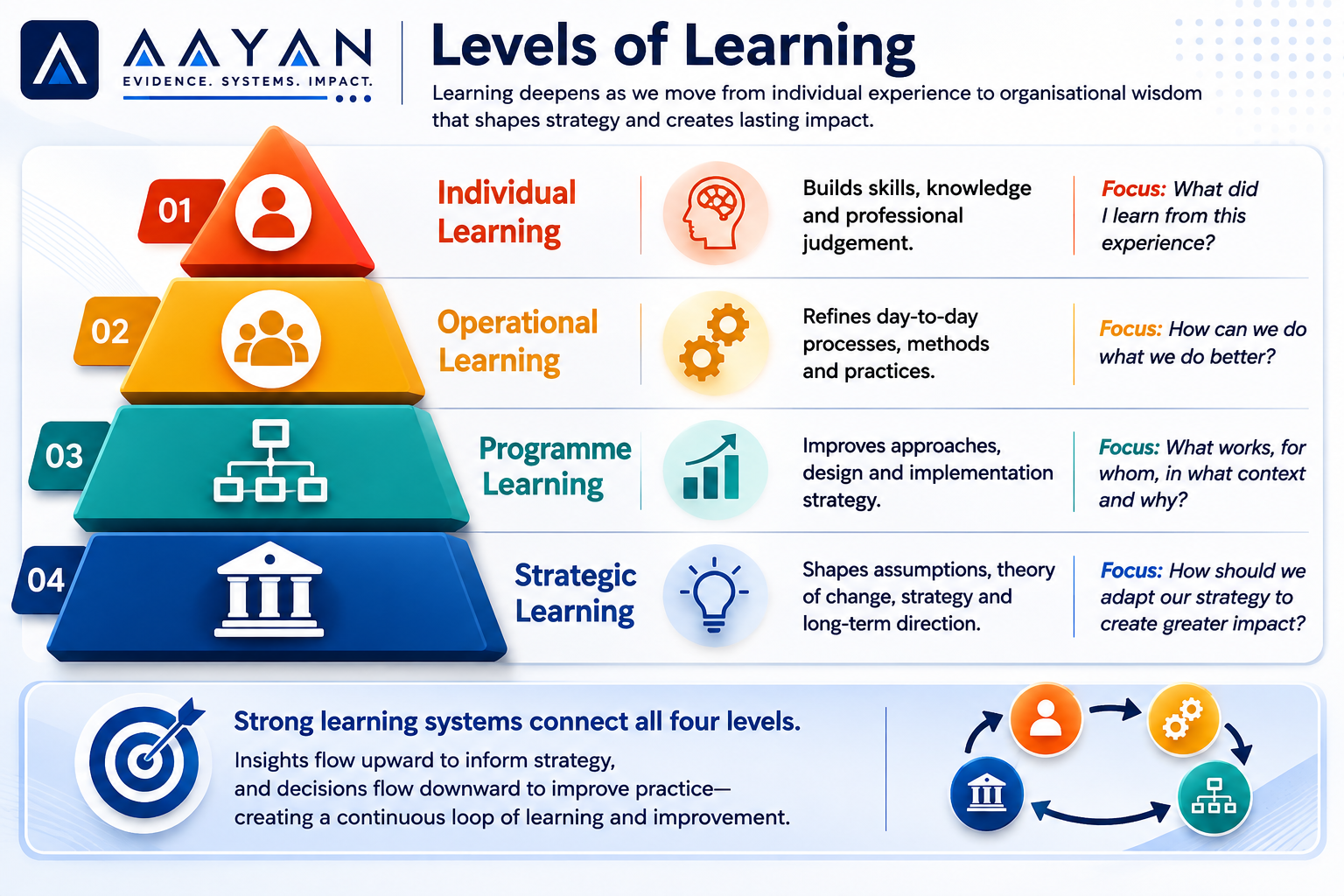
Figure 2. Learning operates at four connected levels — individual, operational, programme and strategic — with insight flowing upward and decisions flowing back down.
Learning therefore requires interpretation and judgement. Evidence needs to be considered in relation to context, programme objectives and the Theory of Change. Alternative explanations may need to be examined. Different stakeholder perspectives may need to be heard, and uncertainty needs to be recognised rather than concealed.
This leads to the central proposition underpinning the article:
Data becomes evidence through analysis. Evidence contributes to learning through interpretation and reflection. Learning improves judgement. Better judgement informs decisions.
This distinction also explains why learning should not be equated with reporting. Reporting primarily communicates what has happened, what progress has been made and what stakeholders need to know. Learning asks what that evidence means, why the observed pattern may be occurring and what implications follow. Both are necessary. The problem arises when producing the report becomes the final destination of the evidence.
The next question is what programmes do when learning indicates that the existing approach may no longer be sufficient. This is where adaptive management becomes important.
5. Why Adaptive Management Is Necessary
Development programmes need plans. They require objectives, budgets, implementation arrangements, responsibilities, indicators, risk frameworks and a credible explanation of how activities are expected to contribute to change. Adaptive management is not an argument against planning. Rather, it recognises that even a well-designed plan cannot anticipate every factor that will influence implementation and outcomes over the life of a programme.
Adaptive management is the deliberate use of emerging evidence, experience and contextual understanding to inform programme decisions and adjust implementation, strategy or resource use when learning or changing circumstances indicate that a different response may be needed.
It is therefore more than flexibility or responsiveness. Adaptation should be purposeful, proportionate to the issue, informed by credible evidence and subject to appropriate decision-making and accountability. This matters because development interventions operate within changing social, political, institutional and economic systems. Different actors respond to different incentives, relationships evolve, policies and institutional priorities shift, and new risks and opportunities emerge. Programme interventions may themselves influence the environment in which later activities take place. Some of this uncertainty can be reduced through strong analysis before implementation, but other uncertainties become visible only through implementation itself.
This has important implications for the Theory of Change. A Theory of Change should articulate how and why a programme expects change to occur, but its pathways and assumptions can also provide propositions that are examined as evidence accumulates. Used in this way, the Theory of Change is not a fixed prediction to be defended regardless of what happens. It becomes a testable representation of how change is expected to occur, allowing programmes to assess whether the assumptions underpinning their intervention remain credible as implementation progresses.
Different forms of evidence contribute to that assessment. Monitoring can show whether implementation and expected progress are moving as anticipated, while evaluation can examine outcomes and provide deeper explanation of what is working, for whom and why. Contextual and political economy analysis can reveal changes in the external environment, and participant and partner feedback can identify barriers, experiences or unintended effects that formal indicators may overlook. Structured reflection then provides an opportunity to consider these different sources together and examine whether programme assumptions, delivery approaches or strategic choices remain appropriate.
Adaptive management translates this emerging understanding into programme decisions and, where warranted, changes in programme action. Importantly, this does not mean that every new finding should trigger a change. The response should be proportionate to the strength of the evidence, the significance of the issue, the risks involved and the consequences of the decision. A reversible operational adjustment may reasonably be informed by timely monitoring and feedback, while a major strategic redesign would normally require stronger and more diverse evidence.
The wider literature on organisational learning reinforces this approach. Experiential learning emphasises that experience becomes useful when it is reflected upon, interpreted and used to inform subsequent action (Kolb, 1984). The distinction between single-loop and double-loop learning is particularly relevant for development programmes. Single-loop learning improves an existing approach while leaving its underlying assumptions broadly intact; double-loop learning goes further by questioning whether those assumptions remain valid (Argyris & Schön, 1978). A programme experiencing low participation, for example, might initially change the timing or location of an activity. Deeper reflection may reveal that the problem lies not in delivery but in assumptions about access, incentives or decision-making power.
Problem-Driven Iterative Adaptation (PDIA) brings a similar logic into development practice by emphasising locally grounded problems, iterative experimentation, feedback and adjustment (Andrews, Pritchett & Woolcock, 2013). Across these perspectives, the practical implication is similar: implementation itself generates knowledge, and programmes need the capacity to use that knowledge as their understanding of the problem and context develops.
This reinforces a simple principle:
Plans provide direction, while learning provides the means to test whether the programme should continue following that direction in the same way.
Adaptive management provides the disciplined means of acting on that learning when change is necessary. The question then becomes how the relationship between evidence, learning, decisions and adaptation can be organised systematically within programme management. The next section addresses this through the Adaptive Learning Cycle.
6. The AAYAN Adaptive Learning Cycle
The practical challenge is to organise learning in a way that consistently connects evidence with programme decisions, without turning learning into another layer of programme hierarchy. Drawing on established practice in evaluation, organisational learning and adaptive management, the AAYAN Adaptive Learning Cycle brings these processes together as a practical management pathway:
Observe → Generate Evidence → Interpret → Reflect → Decide → Adapt → Implement → Monitor → Evaluate the Adaptation → Institutionalise Learning
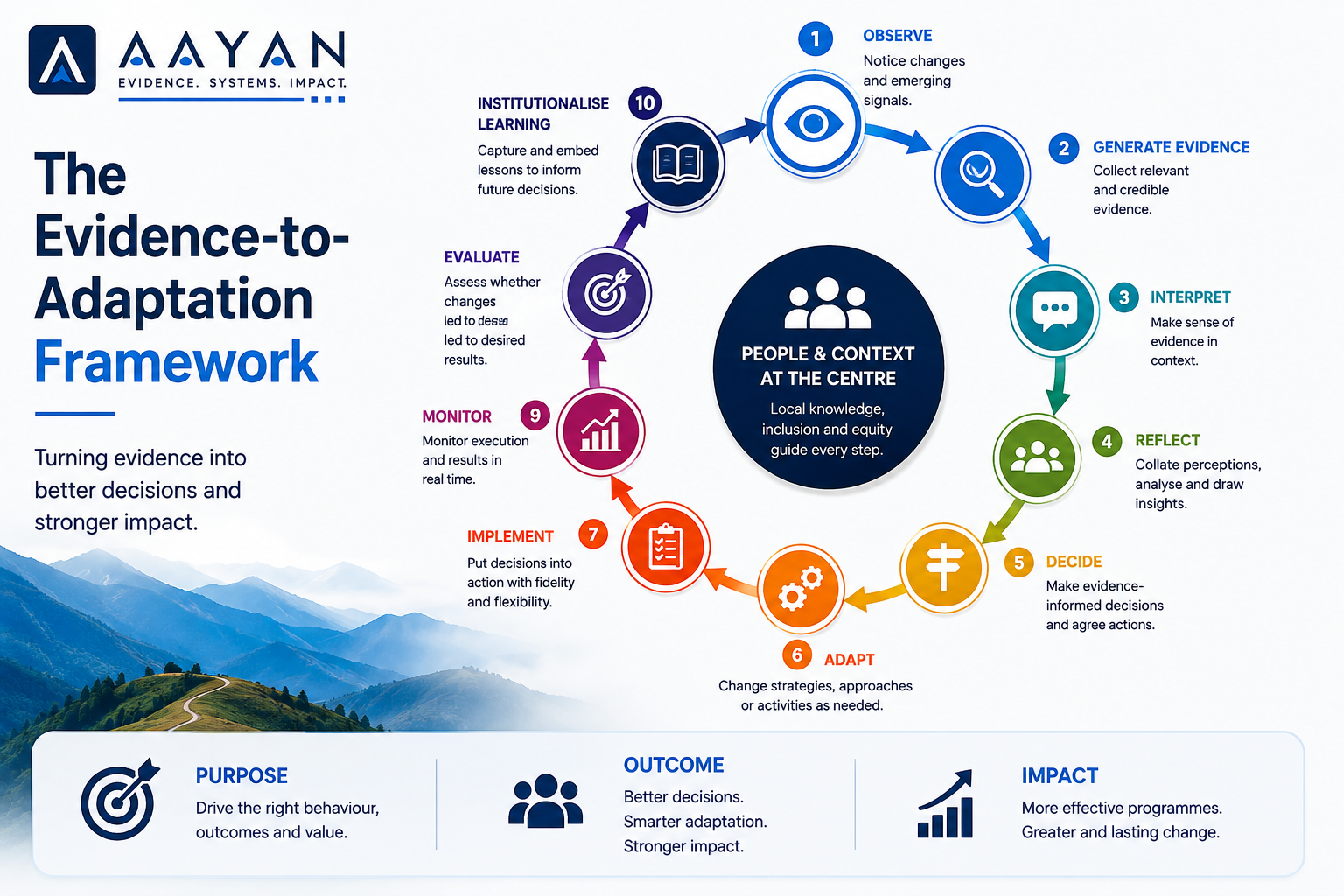
Figure 3. The AAYAN Adaptive Learning Cycle, with people and context deliberately placed at its centre.
The individual elements of the cycle are well established across learning and adaptive-management practice. Bringing them together helps make explicit the transitions that are often weak in programmes: recognising an emerging issue, establishing what the evidence actually shows, interpreting its implications, reaching a decision, following that decision through into implementation, and determining whether the resulting adaptation worked and should influence future practice.
The cycle begins with observation. Programmes continuously encounter signals through routine monitoring, participant feedback, partner experience, financial information, complaints and safeguarding mechanisms, contextual developments and frontline observation. Not every signal requires action, but unexpected or recurring patterns should be recognised rather than disappearing within routine reporting. Where a signal is sufficiently important, the programme may need to generate additional evidence to understand it. The level of inquiry should be proportionate to the issue and the decision involved: a low-risk operational question might be addressed through monitoring analysis and rapid participant feedback, while a potential strategic change may require stronger triangulation, additional research or evaluation.
Evidence then needs to be interpreted rather than taken at face value. Teams should consider its strength, alternative explanations, variation between groups or locations, contextual influences and whose perspectives may be missing. Reflection provides the deliberate space to consider what this evidence means for the programme, including whether existing assumptions remain credible. The discussion therefore moves beyond “What happened?” towards “Why might this be happening, what does it tell us about our assumptions and approach, and what are the implications?”
Reflection should ultimately inform a decision, although that decision does not necessarily have to involve change. The programme may decide to continue as planned because the evidence supports the existing approach, gather further evidence where uncertainty remains, test an alternative, make an adjustment, or stop an activity. This is an important transition: a learning meeting that generates useful discussion but never reaches a clear conclusion may improve understanding without influencing programme management.
Where change is warranted, the programme adapts. Adaptation may involve relatively modest changes to timing, communication, sequencing or delivery, or more substantial changes to targeting, partnerships, resources, measurement or programme strategy. The distinction between deciding and implementing the adaptation is important. Decisions have limited value if no owner is assigned, workplans and resources remain unchanged, required approvals are not obtained, or partners and affected stakeholders are not informed.
Implementation does not complete the learning process. The programme should monitor whether the adaptation was carried out as intended and whether early effects or unintended consequences are emerging. It should then evaluate the adaptation proportionately to determine whether the change addressed the original issue and whether it should be retained, refined, scaled, reconsidered or stopped. This does not imply commissioning a formal evaluation for every adjustment; the depth of assessment should reflect the significance and risk of the change.
Finally, useful learning should be institutionalised. Where an adaptation produces important learning, the implications may extend beyond the immediate activity. The programme may need to revise its Theory of Change, operating procedures, partnership arrangements, staff guidance, risk framework or future programme design. Institutionalisation is what helps prevent valuable learning from remaining with particular individuals or being lost when teams change or programmes close.
Although presented as a cycle, the process should not be interpreted as mechanically linear. Reflection may reveal that additional evidence is required; monitoring may show that an agreed adaptation was not implemented as intended; and evaluation may challenge the original interpretation and send the programme back to an earlier stage. The cycle can also operate at different speeds. A relatively minor implementation issue may move through much of the process within days or weeks, while a strategic question affecting the Theory of Change may require a longer period of evidence generation, consultation and governance review.
The discipline lies not in completing ten stages in sequence, but in ensuring that the critical connections between evidence, learning, decisions, action and reassessment are not routinely lost.
7. What Makes the Cycle Work
A framework alone does not create a learning programme. The Adaptive Learning Cycle depends on organisational conditions that allow evidence to move from generation and interpretation into decisions, action and subsequent learning. Six conditions are particularly important: decision-relevant evidence, structured reflection, meaningful participation, clear decision authority, an enabling organisational culture and institutional memory.
The starting point is decision-relevant evidence. Programmes need to be clear not only about what they want to learn, but why that knowledge matters. A learning agenda can help identify priority questions around uncertainties in the Theory of Change, persistent implementation or performance problems, contextual changes and forthcoming management decisions. Its purpose is not to create another extensive research plan, but to focus inquiry on uncertainties that have consequences for programme choices.
For example, asking “Why is participation consistently lower among women in particular locations, and what changes in programme design might improve access?” is more useful for adaptive management than simply asking “What barriers do women face?” Both questions may generate useful knowledge, but the first makes the connection to a programme problem and a potential decision explicit. This decision orientation helps prevent learning agendas from becoming lists of interesting questions that are never used.
Evidence also needs structured reflection. Learning should not depend on whether individual staff happen to discuss an issue informally or whether a particularly engaged manager decides to raise it. Programmes need deliberate opportunities to bring together different sources of evidence, examine what they mean and consider their implications. This does not necessarily require additional meetings. Existing management processes can often serve this purpose if they move beyond progress updates and reporting towards interpretation, challenge and decision-making.
A third condition is meaningful participation. Programme participants, communities, local organisations and implementing partners should not be treated only as sources from whom information is extracted. Their knowledge can help identify relevant questions, explain patterns that monitoring data alone cannot explain, challenge programme assumptions and assess whether a proposed response is realistic in context. Meaningful participation does not imply that every actor has equal authority over every programme decision. It means establishing credible routes through which relevant local knowledge and lived experience can influence programme judgement.
For that judgement to result in action, programmes also need clear decision authority. Evidence has limited operational value if a team agrees that something should change but no one knows who has the authority to approve the change. Programmes should therefore be sufficiently clear about which adjustments can be made by implementation managers, which require programme leadership, and which require donor, governance, contractual or other formal approval. Greater clarity about decision rights also helps prevent two opposite problems: useful adaptations being delayed unnecessarily, and significant changes being made without appropriate oversight.
This leads to an important principle:
MEL facilitates evidence and learning; programme leadership owns programme decisions; the whole programme contributes knowledge.
Learning should therefore not be assigned to the MEL function alone. MEL teams can strengthen evidence quality, synthesise findings, identify patterns and facilitate reflection, but they cannot substitute for programme managers and leaders who control programme choices, budgets, partnerships and implementation. Nor should programme knowledge flow in only one direction: frontline teams, technical staff, partners and participants all contribute different forms of knowledge that may be important to management decisions.
A fifth condition is an organisational culture that allows difficult evidence to surface. If staff and partners believe that identifying a problem, questioning an assumption or reporting an unsuccessful approach will automatically result in blame or reputational damage, difficult information is less likely to travel through the system. Evidence reaching senior management may become increasingly selective even when monitoring systems themselves remain technically sound. Psychological safety therefore matters not only for staff wellbeing or organisational culture, but also for the quality and completeness of the evidence available for decision-making.
This does not mean weakening accountability or treating every failure as acceptable. Responsible experimentation needs to be distinguished from negligence, just as honest reporting needs to be distinguished from concealment. A learning-oriented culture creates space to acknowledge uncertainty, challenge assumptions and identify poor performance early enough for the programme to respond.
The sixth condition is institutional memory. Important decisions, the evidence and reasoning behind them, the adaptations that followed and what subsequently happened need to remain retrievable. Otherwise, individuals and teams may learn while the wider organisation repeatedly loses that knowledge through staff turnover, programme closure or weak documentation. Institutional memory does not require documenting every routine management decision. It requires retaining significant learning in forms that can inform future implementation, programme design and organisational practice.
Taken together, these conditions show why learning cannot be created simply by adding a learning workshop or another reporting product to a programme.
A functioning learning system needs relevant evidence, deliberate reflection, voices that can challenge programme assumptions, authority to act, an environment in which difficult evidence can surface, and mechanisms that prevent useful learning from disappearing.
8. Embedding Learning in Programme Management
One of the most common mistakes is to treat learning as a separate event, usually through a workshop held quarterly, annually or near programme closure. A more useful approach is to embed different forms of learning within the normal rhythm of programme management, with the frequency and depth of review reflecting the nature of the issue and the decision that may follow.
Operational issues generally require relatively rapid attention, while patterns emerging from monitoring may need monthly interpretation. More substantial questions about assumptions, inclusion, partnerships or programme strategy may require quarterly or six-monthly reflection. Questions that challenge the Theory of Change or overall strategic direction may be better addressed through evaluation, annual review or a dedicated strategic review.
There is therefore no universal learning calendar. The appropriate rhythm depends on programme pace, risk, complexity, contextual volatility and the decisions that need to be made. A programme operating in a rapidly changing humanitarian or political environment may require short feedback cycles, while a long-term institutional-capacity programme may reasonably work at a different pace. Similarly, a pilot may require intensive early learning because uncertainty is high, whereas a mature intervention with stable performance may need less frequent review.
The important point is to connect different management rhythms to different learning purposes. Routine implementation meetings can identify immediate delivery problems; monitoring reviews can examine patterns, exceptions and emerging risks; pause-and-reflect sessions can bring together different forms of evidence and revisit assumptions; and after-action reviews can capture learning immediately following a major activity, event or implementation milestone. Evaluation can provide deeper assessment where the questions and stakes justify it, while annual or strategic reviews can consider performance, risk, value and programme direction together.
These mechanisms should complement rather than duplicate one another. A quarterly learning session should not become another presentation of indicators already discussed in monthly monitoring meetings. Its value lies in asking deeper questions: What are we learning from the pattern? What assumptions are being challenged? Whose perspectives are missing? What should we continue, change, investigate or stop?
Similarly, an annual review should not be the first occasion on which a programme responds to a problem that monitoring identified nine months earlier. Learning works best when evidence reaches the programme at the point when a relevant decision can still be made.
9. From Reflection to Adaptation: When Is Change Justified?
Not every finding should lead to programme change. This is an important safeguard because adaptive management can otherwise become confused with responsiveness for its own sake. Programmes need to distinguish between recognising an emerging issue, understanding what it means, deciding whether action is warranted and determining what happens after that action.
A useful sequence is:
Signal → Finding → Interpretation → Decision → Adaptation → Result.
A signal suggests that something may deserve attention. A finding has sufficient evidential support to warrant serious consideration. Interpretation concerns what the finding means and what may explain it. A decision determines the appropriate response, which may or may not involve change. Adaptation is the change that is actually implemented, while the result concerns what happens afterwards.
Keeping these stages distinct reduces the risk of moving directly from an isolated observation to a significant programme response. Before making a substantial adaptation, managers should consider whether the evidence is sufficiently credible for the decision being contemplated; whether the issue materially affects outcomes, quality, equity, risk or value; whether the pattern is repeated or supported by different sources; and whether plausible alternative explanations have been considered. They should also consider whether participants and partners recognise the issue, whether the proposed response is feasible and proportionate, what new risks it might create, who has authority to approve it and whether its effects can subsequently be assessed.
These considerations do not produce an automatic answer. Their purpose is to improve judgement. A weak but potentially important signal may justify a low-risk pilot rather than programme redesign. A strong finding that challenges a core assumption may require strategic review. A credible finding whose solution falls outside the programme’s authority may require escalation rather than local adaptation.
These considerations provide the basis for the AAYAN Evidence-to-Decision Matrix, which can be developed more fully as a companion practice tool rather than adding another detailed framework to this article.
10. Learning Must Include Follow-Through
One of the most neglected parts of programme learning is what happens after a decision has been made. Development programmes often invest considerable effort in identifying lessons and agreeing recommendations, but less attention may be given to whether the resulting actions were implemented and whether they actually improved performance.
A concise decision record can strengthen this connection without creating a heavy reporting burden. For significant decisions, a programme should be able to identify the issue, the evidence considered, the interpretation or rationale, the decision taken, who owns the resulting action and when its consequences will be reviewed. The principle is more important than the template: an important adaptation should be traceable from the evidence that informed it through to the action taken and the subsequent result.
This is also where evaluation and evaluative thinking re-enter the learning process. Evaluation should not be understood only as a large external exercise undertaken at midline or programme completion. FCDO’s Evaluation Strategy 2026–2030 recognises a wider role for evaluative thinking and proportionate evidence in supporting learning, feedback and adjustment during implementation (FCDO, 2026).
The depth of assessment should therefore reflect the significance of the adaptation. Changing the timing of community meetings may require little more than comparison of participation patterns and feedback from participants. A substantial redesign of an intervention, by contrast, may justify more systematic evaluation and stronger evidence before conclusions are drawn.
The central point is straightforward:
Adaptation is not evidence of improvement. It is a response that itself needs to be tested.
This is why Evaluate the Adaptation is explicitly included in the Adaptive Learning Cycle. Without this step, programmes can document that they responded to evidence without knowing whether the response improved anything.
11. How Do We Know Whether a Programme Is Learning?
Learning cannot be assessed simply by counting workshops, reports, learning briefs or evidence products. Such measures may demonstrate that learning-related activities occurred, but they tell us little about whether evidence influenced programme behaviour or whether the organisation became better at using experience.
A stronger assessment follows the pathway from evidence to action. Programmes can examine whether priority learning questions are linked to credible evidence; whether participant and partner perspectives influence interpretation; whether structured reflection takes place when important evidence emerges; whether significant decisions record the evidence and reasoning behind them; whether agreed adaptations are actually implemented; and whether their effects are subsequently reviewed. At a deeper level, programmes can ask whether important learning has changed guidance, systems, resource allocation, assumptions, programme design or future practice.
Organisational culture is part of this assessment. If staff and partners are reluctant to raise uncertainty, poor performance or unexpected findings, formal learning mechanisms may exist without functioning effectively. Periodic feedback on whether people feel able to challenge assumptions and surface difficult evidence can therefore provide useful insight into the credibility of the learning system.
The objective, however, is not to turn learning into another indicator-heavy compliance framework. Programmes should select a small number of measures that help them understand whether their learning arrangements are functioning and where improvement is needed.
Over time, this assessment can also consider progression: from programmes that primarily collect data for reporting, through stronger analysis and structured reflection, towards managed adaptation and ultimately institutional learning. This provides the basis for an AAYAN Learning Maturity Model. As with the Evidence-to-Decision Matrix, the detailed diagnostic is better developed in the companion practice paper or toolkit rather than fully elaborated here.
12. What Should Programmes Put in Place?
Effective learning and adaptive management do not necessarily require a large new architecture. Most programmes already possess many of the components they need: monitoring systems, evaluations, management meetings, participant and partner feedback mechanisms, annual reviews, risk processes and programme governance arrangements. The challenge is often not to create more processes, but to connect existing ones more deliberately around learning and decisions.
At minimum, a programme should be clear about what it needs to learn, particularly where important assumptions, uncertainties or forthcoming decisions are involved. It needs credible and proportionate ways of generating evidence and regular opportunities to interpret that evidence with people who bring relevant technical, operational and lived experience. Decision authority needs to be sufficiently clear for learning to lead to action, while significant adaptations should have identified owners and a concise record of what was decided and why. Their consequences should subsequently be reviewed, and learning with wider relevance should be incorporated into programme systems, guidance, the Theory of Change or future design rather than remaining with individuals.
The precise arrangements will vary. A small programme should not be expected to establish the same learning architecture as a large, multi-country portfolio, and a stable intervention does not require the same review rhythm as a programme operating in a volatile environment. Templates, meetings and evidence requirements should therefore remain proportionate to programme scale, complexity, risk and context.
What should remain consistent is the management logic. A programme should be able to answer a connected set of questions:
What did we observe? What evidence did we generate? What did we understand differently? What decision followed? What changed? And what happened after the change?
These questions provide a practical test of whether learning is functioning as a programme-management capability rather than simply appearing as a reporting label.
13. Conclusion: Learning as a Management Capability
Development programmes do not become learning organisations simply by collecting more data, commissioning more evaluations or adding learning sections to reports. Evidence is indispensable, but generating evidence is only one part of the process. The greater challenge is creating the conditions through which evidence and experience can influence understanding, judgement and programme decisions.
Programmes learn when evidence is interpreted rather than simply reported; when assumptions can be questioned; when participant, partner and frontline perspectives can influence understanding; when decision-makers have both the authority and willingness to respond; and when the consequences of those decisions are subsequently examined. Learning therefore belongs within programme management rather than at its margins, and it cannot be assigned to the MEL function alone.
This also clarifies the relationship between functions that are frequently brought together but not always clearly distinguished. Monitoring helps programmes understand what is happening during implementation and identify emerging patterns or problems. Evaluation provides more systematic assessment and deeper examination of performance, outcomes and explanations. Learning changes, refines or confirms understanding and improves subsequent judgement. Adaptive management connects that understanding with programme decisions and, where warranted, changes in action. Knowledge management helps retain and share what has been learned so that useful knowledge is not lost.
The AAYAN Adaptive Learning Cycle brings these relationships together as a practical programme-management pathway:
Observe → Generate Evidence → Interpret → Reflect → Decide → Adapt → Implement → Monitor → Evaluate the Adaptation → Institutionalise Learning
Its value does not lie simply in the number or naming of its stages. The more important issue is what happens between them. A programme can have strong monitoring data but weak interpretation; thoughtful reflection but unclear decision authority; sound decisions that are never implemented; adaptations that are implemented but never assessed; or valuable learning that disappears when staff leave or programmes close. These breaks in the process are where the Learning Gap becomes visible in practice.
Closing these gaps requires more than additional tools. It requires evidence that is relevant to decisions, deliberate opportunities for reflection, meaningful participation, clear decision authority, proportionate follow-through, an organisational culture in which difficult evidence can surface, and mechanisms for retaining important learning. Most programmes already possess many of the individual components. The challenge is to connect them so that evidence can move through the programme and influence what happens next.
The practical test is therefore straightforward:
What did the programme learn? What decision did that learning inform? What changed as a result? And what did the programme learn from that change?
When programmes can answer these questions consistently, learning is no longer an event, a workshop or a reporting requirement. It becomes a programme-management capability: a disciplined way of using evidence and experience to improve judgement, respond to changing circumstances and strengthen future action.
That is the point at which adaptive management moves from aspiration to practice.
References
Andrews, M., Pritchett, L., & Woolcock, M. (2013). Escaping capability traps through problem-driven iterative adaptation (PDIA). World Development, 51, 234–244.
Argyris, C., & Schön, D. A. (1978). Organizational learning: A theory of action perspective. Addison-Wesley.
Buell, S. (2020). Asking for feedback: How to ensure information makes its way into decision-making. ODI.
Desai, H., Maneo, G., Pellfolk, E., & Schlingheider, A. (2018). Managing to adapt: Analysing adaptive management for planning, monitoring, evaluation, and learning. Oxfam Research Reports. Oxfam.
European Commission, Directorate-General for International Partnerships. (n.d.). What is monitoring? European Commission.
Foreign, Commonwealth & Development Office (FCDO). (2025). FCDO evaluation policy (reviewed January 2025). UK Government.
Foreign, Commonwealth & Development Office (FCDO). (2026). FCDO evaluation strategy 2026 to 2030. UK Government.
Kolb, D. A. (1984). Experiential learning: Experience as the source of learning and development. Prentice-Hall.
ODI. (2021). LearnAdapt: Lessons from three years of adaptive management. Overseas Development Institute.
OECD. (2023). USAID: Collaborating, learning and adapting. Development Co-operation: Tools, Insights and Practices. OECD Publishing.
Suggested citation: Elahi, A. (2026). Learning and Adaptive Management: Turning Evidence into Better Decisions. AAYAN Knowledge Hub.
About the AAYAN Knowledge Hub
The AAYAN Knowledge Hub is a practitioner-focused platform for sharing evidence, methods, tools and applied learning across monitoring, evaluation, research, learning, adaptive management and development practice. It aims to connect established knowledge with practical experience and provide accessible resources that support stronger evidence use, programme management and decision-making.
About the Author
Ajmal Elahi is a monitoring, evaluation, research and learning practitioner with more than 18 years of experience across development programmes in Pakistan. His work spans programme monitoring and evaluation, research, learning and adaptive management, management information systems, value for money and evidence-informed programme management. He is the Founder and Director of AAYAN Management Solutions (Pvt.) Ltd. and contributes to the AAYAN Knowledge Hub on applied approaches to evidence, systems and programme learning.