
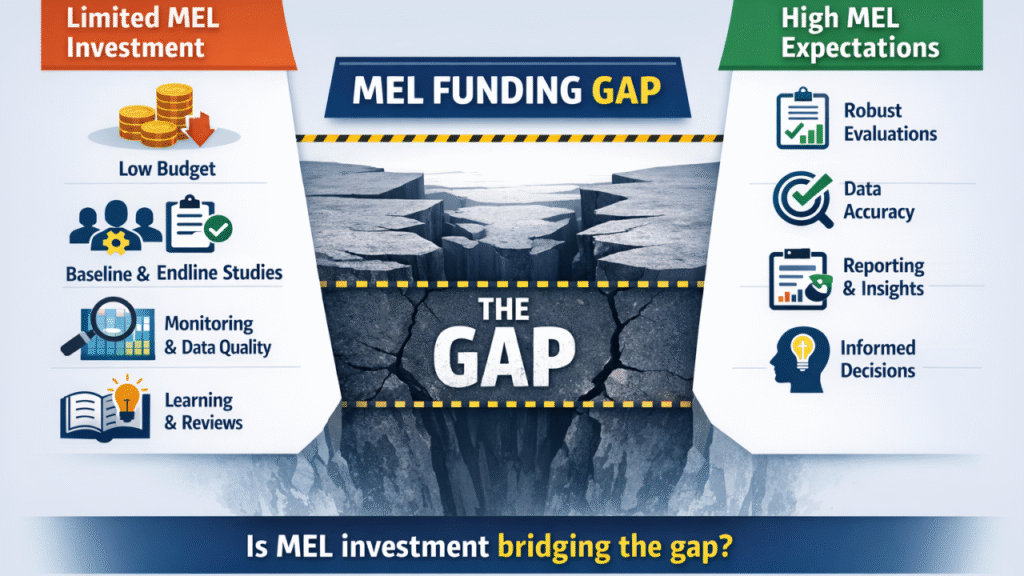
As development programmes increasingly emphasise accountability, evidence, adaptive management, and measurable results, Monitoring, Evaluation and Learning (MEL) systems are expected to play a central role in programme success. Yet despite these growing expectations, MEL often remains one of the least resourced functions within programme design and implementation. This article reflects on a recurring challenge observed across the development sector.
In most development programmes, Monitoring, Evaluation and Learning (MEL) is expected to drive accountability, evidence, and results, yet it remains one of the least resourced functions.
Over the past two decades, my work with national and international organisations, including through AAYAN and independent engagements, has involved managing MEL functions across multi-donor programmes covering diverse thematic areas, from reconstruction, rehabilitation, and livelihoods to education, health, governance, public policy, inclusion, GBV, child marriage, and electoral reforms. This includes major programmes such as the USAID Citizens’ Voice Project, the FCDO-funded Consolidating Democracy in Pakistan Programme (CDIP), and Aawaz II, among others.
Across many of these programmes, millions were invested in implementation. However, comparatively limited attention was often given to MEL. There are, of course, examples where MEL has been adequately resourced and structured, reflecting a deliberate investment in evidence and learning. At the same time, expectations from MEL systems have remained consistently high, ranging from data quality, reporting, and analysis to demonstrating results, outcomes, and impact.
This is where the gap becomes evident in practice.
Where the Gap Becomes Evident in Practice
In many cases, even basic MEL requirements are not adequately resourced. Dedicated MEL staff are not always in place, with the expectation that project managers or implementation teams will manage MEL functions alongside their core responsibilities.
Funding for baseline studies is often missing, and similar gaps exist for periodic monitoring, midline and endline evaluations, data quality assessments, and structured learning and review processes that support course correction and adaptive programming.
As a result, programmes may be expected to demonstrate evidence and impact without having invested sufficiently in the systems required to generate that evidence.
How MEL Is Often Treated
Over time, these gaps have been recognised to some extent. Some programmes have started allocating resources for MEL, and frameworks have become more defined.
However, in many cases, MEL remains limited to initial compliance requirements, focused primarily on developing logframes, performance management plans, indicators, or MEL plans during inception, rather than being fully embedded throughout the programme lifecycle.
When this happens, MEL risks becoming a reporting function rather than a strategic tool for evidence generation, learning, and decision-making.
What the Evidence Suggests
While some organisations, such as Oxfam, have established indicative benchmarks around 5% of programme budgets for MEAL, and examples from practice within the sector often fall within a 3–7% range, there is still no consistently applied standard across development programmes.
Across major donors, including USAID, FCDO, the World Bank, and the European Commission, MEL systems are recognised as an essential component of programme design and accountability. However, no universally applied budget benchmark exists, resulting in significant variation in how MEL functions are resourced in practice.
Consequently, expectations often remain standardised, while investment levels vary considerably from programme to programme.
Why This Matters
This gap has real implications.
Weak baselines, limited monitoring, insufficient investment in learning, and under-resourced evaluation systems directly affect the quality of evidence available to programmes. It becomes more difficult to demonstrate results, inform decisions, identify emerging challenges, or adapt interventions effectively.
In some cases, MEL risks becoming a compliance exercise focused on reporting outputs rather than understanding outcomes, learning from implementation, and improving programme effectiveness.
As development programmes increasingly emphasise adaptive management, evidence-based decision-making, and value for money, the importance of adequately resourced MEL systems becomes even more critical.
Moving Beyond Compliance
MEL should not be treated as a compliance requirement. It should be recognised as a strategic function that supports accountability, learning, adaptation, and improved programme performance.
Greater clarity around minimum expectations, stronger alignment between programme ambitions and MEL resources, and a more deliberate investment in evidence systems would help strengthen both programme effectiveness and accountability.
If MEL is expected to drive results, are we investing in it accordingly?
It is a question that deserves more deliberate attention across the development sector.
About the Author
Ajmal Elahi is the Founder of AAYAN and an evidence, learning and advisory specialist with over 18 years of experience working across governance, development, humanitarian and institutional strengthening programmes. His work spans monitoring, evaluation, research, organizational learning, value for money, institutional performance, governance systems, digital transformation and evidence-informed decision-making. Through AAYAN, he works with development partners, public institutions and organizations to strengthen systems, improve performance and bridge evidence, systems and impact.
About AAYAN Knowledge Hub
This article is part of AAYAN’s Knowledge Hub, a platform for sharing practical insights, evidence, systems thinking and perspectives on monitoring, evaluation, learning, governance, institutional performance, digital transformation and sustainable impact.
Related Articles
• Understanding MEAL: Monitoring, Evaluation, Accountability and Learning
https://ayansolutions.net/understanding-meal/
• AI Is Learning from Humans: Are We Losing the Habit of Critical Thinking?
https://ayansolutions.net/ai-and-critical-thinking/