
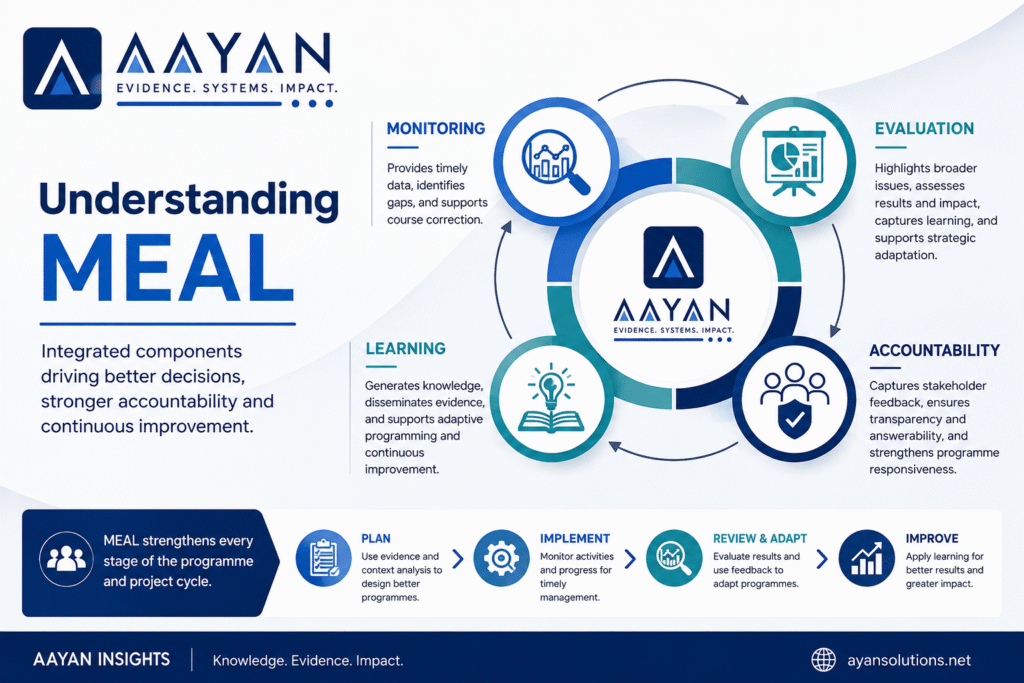
Monitoring and evaluation (M&E) is the backbone of any development intervention. It ensures high-quality implementation, provides timely information for informed management decisions, and measures contributions to outcomes and impacts. M&E and MEAL are often used interchangeably depending on contexts and programme needs. Over time, the M&E moniker has been augmented to include accountability and learning. Most development agencies, therefore, began using Monitoring, Evaluation, Accountability and Learning (MEAL) in place of M&E.
While the two terms are often used interchangeably, MEAL reflects a broader approach that emphasises not only performance measurement but also accountability to stakeholders and organisational learning. This article briefly explains these terminologies while commenting on their differences, interrelationships and practical application in development programming.
Monitoring
Monitoring is a continuous process used to keep project activities and progress on track, identify day-to-day issues through process monitoring, and provide timely information to management and stakeholders for informed decision-making and course correction.
Monitoring helps programme teams assess whether planned activities are being implemented as intended, whether targets are being achieved, and whether resources are being utilised efficiently. Effective monitoring provides regular feedback throughout implementation and supports adaptive management where required.
Evaluation
Evaluation is a process for ensuring and assessing the effectiveness, relevance, efficiency, impact and sustainability of interventions. It is performed periodically and its scope differs from case to case. Evaluations may be formative or summative.
Evaluation may be specific to a particular project or may involve meta-evaluations for complex programmes covering multiple themes and sectors. Its scope also varies depending on context. Evaluations may be conducted according to a planned schedule or in response to immediate needs identified through process monitoring, changing political situations, contextual shifts or sudden disasters.
Accountability
Accountability is a key feature that makes all concerned programme and project stakeholders accountable. It gives power to beneficiaries, donors, clients and other relevant stakeholders to hold implementing agencies accountable for their interventions, actions, policies and priorities.
Accountability mechanisms include complaint handling systems and feedback practices, particularly for women, persons with disabilities, minorities, transgender persons and other marginalised communities. Effective accountability systems strengthen transparency, trust and responsiveness while ensuring that programmes remain focused on the needs and priorities of intended beneficiaries.
Learning
Learning is a key success factor for refining programming by adding value for improvement, revising strategies, and updating plans and frameworks based on key lessons learned, findings and recommendations.
Learning contributes to the generation of knowledge products, dissemination of information, and improved use of evidence by both internal and external programme stakeholders. It supports adaptive programming and helps organisations continuously improve their interventions and approaches.
Linking the Components of MEAL
All components of MEAL are critical and linked with one another. Each component plays a vital role and contributes to other components by providing input and feedback for improvement. All MEAL components are cross-cutting and crucial to ensuring quality standards throughout the programme and project cycle.
Baseline and pre-evaluation data help design and frame programme interventions during the planning and design stage. This information provides critical input for defining theories of change, developing results frameworks, identifying key performance indicators, establishing baseline values and determining data collection methodologies.
Day-to-day monitoring exercises through desk-based and field-based monitoring provide regular insights into the timely accomplishment of interventions, partner performance and quality of work. These processes support timely and informed management decisions and facilitate course correction where necessary.
Periodic evaluations and situational or contextual analyses help programmes make necessary adjustments through adaptive programming based on evaluation findings, stakeholder suggestions, lessons learned and changing political, social and economic contexts.
Accountability and Adaptive Programming
Accountability is a core value of programmes and projects and should be ensured at all levels, including management, staff, beneficiaries, donors and other relevant stakeholders.
Accountability management practices, such as functional complaint handling systems, provide timely input for course correction, design modifications and, where required, staffing adjustments, particularly when ethical standards and organisational values are not being upheld.
Accountability mechanisms also provide important feedback to beneficiaries, donors and other stakeholders, helping programme teams make informed management decisions and necessary adjustments while contributing to future programming.
Learning for Continuous Improvement
Each component of MEAL contributes to learning. Learning is built upon all other components and provides high-level information and knowledge to a wider range of stakeholders regarding programme improvements, future programme design and strategy adjustments.
Monitoring generates data, identifies implementation gaps and suggests actions for course correction. Evaluation highlights broader issues, captures lessons learned and contributes to programme-level improvements while informing strategic revisions where required. Accountability mechanisms provide critical stakeholder perspectives and facilitate adaptive programming.
Together, these components create a continuous cycle of evidence generation, reflection, learning and improvement.
Conclusion
MEAL is more than a technical function; it is an integrated approach that supports evidence-based decision-making, accountability and continuous learning. Strong MEAL systems help organisations understand what is working, what is not working and why, while ensuring programmes remain responsive to the needs of the communities they serve.
As development challenges continue to evolve, effective MEAL systems will remain essential for improving programme quality, strengthening accountability and delivering meaningful and sustainable results.
This article is part of AAYAN’s Knowledge Hub, a platform for sharing practical insights, evidence, systems thinking and perspectives on monitoring, evaluation, learning, governance, institutional performance, digital transformation and sustainable impact.
About the Author
Ajmal Elahi is the Founder of AAYAN and an evidence, learning and advisory specialist with over 18 years of experience working across governance, development, humanitarian and institutional strengthening programmes. His work spans monitoring, evaluation, research, organizational learning, value for money, institutional performance, governance systems, digital transformation and evidence-informed decision-making. Through AAYAN, he works with development partners, public institutions and organizations to strengthen systems, improve performance and bridge evidence, systems and impact.
About AAYAN Knowledge Hub
This article is part of AAYAN’s Knowledge Hub, a platform for sharing practical insights, evidence, systems thinking and perspectives on monitoring, evaluation, learning, governance, institutional performance, digital transformation and sustainable impact.
Related Articles
• AI Is Learning from Humans: Are We Losing the Habit of Critical Thinking?
https://ayansolutions.net/ai-and-critical-thinking/
• MEL: High Expectations, Limited Investment – A Gap That Continues to Be Overlooked
https://ayansolutions.net/mel-high-expectations-limited-investment/